A little oracle that fits in your pocket.
Pocket Oracle is a digital companion for contemplation. Every day it greets you with a card to sit with. Draw as many more as you like — tomorrow it'll have something new to say.
Tarot, I Ching, or Runes. Turn the wheel to change who you're asking.
Each system keeps its own answer for the day. Switch away and back, and the same card is still waiting.
Tarot
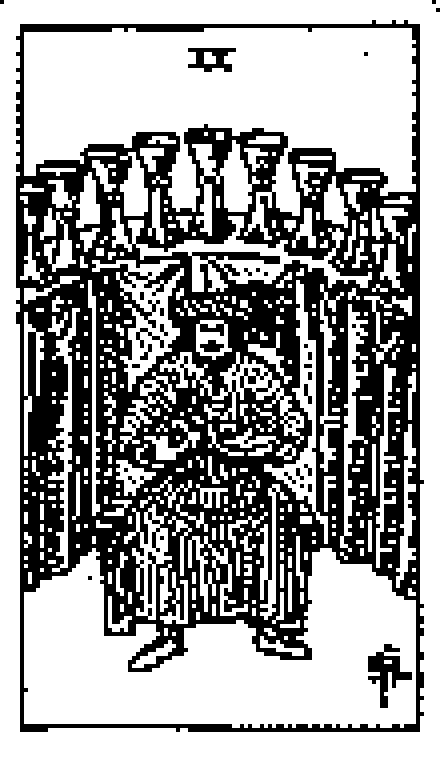
All 78 cards of the 1909 Rider–Waite–Smith deck, carefully dithered for e-paper. One keyword up front; the full reading on the back.
I Ching
A full three-coin cast: your hexagram, its changing lines, and the hexagram it becomes.
Runes
One stone from the Elder Futhark, drawn large — upright or reversed, as it falls.
One card. Every day. Already chosen before you woke up.
Your card of the day is set by the date itself — chosen before you wake, with no shuffling and no notifications. Draw as many more as you like; the day's card stays where it is. The e-paper holds it all day without a battery worry, and at midnight a new one quietly takes its place.
It waits
Face down, all morning if you like. The oracle doesn't nag.
Press to turn
The art, the name, and one word to carry around with you.
Turn it over
Press again for the reading. Written to be read slowly, in a few sentences.
The plan is for anyone who wants one to be able to have one.
Pocket Oracle is being built in the open. How much of it ends up public is still being worked out — parts of it certainly, possibly all of it. That is a decision being made while it is built, not after.
Build it yourself
It runs on off-the-shelf e-paper hardware in a 3D-printed case. As the source goes public, anyone with the time and the tools can make their own — and change it, which is rather the point of putting it out there.
Or have one made
Not everyone has the time or the tools, and that is a fine reason to skip the build. A small batch will be assembled, flashed and ready to sit on a shelf. That is what the waitlist is for.
Questions the cards can't answer
No. Everything — all 78 cards, 64 hexagrams and 24 runes — lives on the device. It keeps its own clock and never phones home.
Draw as many as you like. The difference is that one of them is the card of the day — derived from the date itself, so it is chosen before you wake and waits there until midnight. That is the one to sit with. Everything you draw after it is yours to play with, and none of it displaces the day’s card.
Yes — here are two early prototypes in development: turning the day’s card and a look at the hardware. Both are works in progress, which is rather the point.
E-paper only uses power when the picture changes, and the oracle sleeps between presses. Expect weeks, not days, on a charge over USB-C.
The 1909 Rider–Waite–Smith deck, now in the public domain, carefully dithered to crisp one-bit for the 122×250 panel.
That is the intention, and it is being actively explored while the thing is still being built — parts of it for certain, quite possibly the whole thing. Nothing is published yet, so the honest answer is “not today, but that is where this is heading.” The waitlist gets told when there is something to look at.
Not decided yet. It is being prototyped in the yellow you see here — the jewel tones on this page are possibilities, not promises. The waitlist gets told first.
The first batch is small. Be on the list.
Prototyping in yellow; the final colours aren't settled. We'll write once when it's ready.
Join the waitlist